
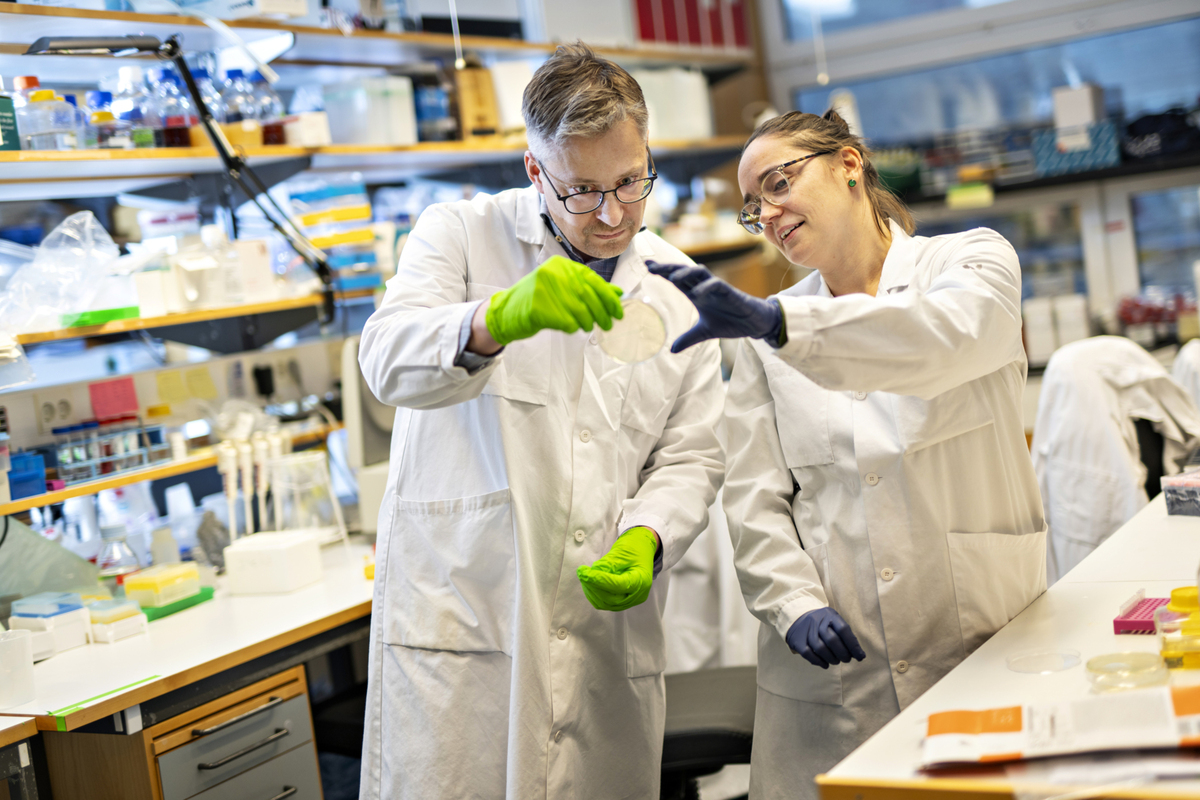
Doctoral student in Chemical Engineering with focus on membrane filtration modules for energy-efficient whey protein valorization in dairy processing
Lund University
Lund University was founded in 1666 and is repeatedly ranked among the world’s top universities. The University has around 47 000 students and more than 8 800 staff based in Lund, Helsingborg and Malmö. We are united in our efforts to understand, explain and improve our world and the human condition.
Lund University welcomes applicants with diverse backgrounds and experiences. We regard gender equality and diversity as a strength and an asset.
The Department of Process and Life Science Engineering (PLE) at Lund University is located at Kemicentrum, one of the Nordics' largest centers for education and research in the field of chemistry. PLE has around 150 employees, of which around 65 are PhD students. The department offers a broad competence in areas such as chemical engineering, food technology, biotechnology and technical microbiology. The research and education at PLE spans the entire subject of chemistry and includes both undergraduate and graduate education. The Department of Process Engineering and Applied Biosciences (PLE) at Lund University works actively to ensure a good working environment through several initiatives and routines. PLE encourages open communication and collaboration between employees, students and management to continuously improve and have regular meetings and dialogues to discuss workplace safety.
Description of the workplace
The Department of Process and Life Science Engineering (PLE) covers a wide range of industrially relevant research, including e.g., dairy processing, processing of plant-based alternative proteins, advanced membrane technology, refining processes for biomass conversion and purification of biopharmaceuticals. The position is a joint position between the Membrane group and Dairy Group in the Department of Process and Life Science Engineering. The Dairy group is working technological and processing aspects on milk and dairy systems, with main research areas within milk quality and genomics, composition and structure of milk and dairy products, dairy processing as well as nutrition and health, while the Membrane Group is the most established membrane research group in Sweden and has with MemLab – the Industrial membrane process research and development centre – an excellent infrastructure to develop and optimize membrane processes from lab to pilot scale.
The project is part of the Horizon Europe MSCA Doctoral Networks 2024 UP2MEM - Materials UP-cycling TO fabricate advanced MEMbrane technologies for water and food industries: towards zero waste and a circular economy. UP2MEM is a wide consortium involving 11-degree awarding universities, 1 national research centre, and 13 companies.
Being a doctoral student
As a doctoral student, you are both admitted as a student and employed at Lund University.
As a doctoral student, you will be trained in a scientific approach. In short, you will be trained to think critically and analytically, to solve problems independently using the right methods, and to develop an awareness of research ethics. In addition, you will have the opportunity to work on projects, to develop your leadership and pedagogical skills. Throughout your studies, you will be guided by supervisors. Doctoral studies end with a thesis and a doctoral degree.
More about being a doctoral student at LTH on lth.se. https://www.lth.se/english/study-at-lth/phd-studies/
Subject and project description
You will be part of a project with the overall aim to develop and optimize membrane-filtration strategies for the concentration of dairy process streams, with a particular focus on whey protein valorization. The work involves identifying the optimal transition point between membrane filtration, evaporation, and spray drying to minimize energy consumption while maintaining product quality. Furthermore, the project will extend the concentration range achievable through membrane processes, thereby reducing reliance on thermal operations. In addition to process optimization, the project will explore novel module designs using computational fluid dynamics (CFD) simulations and advanced manufacturing techniques such as 3D printing. These innovations aim to improve mass transfer, reduce membrane fouling, and enhance energy efficiency. The long-term goal is to develop next-generation membrane systems tailored to the specific needs of the dairy industry.
Work duties
You will primarily devote yourself to your doctoral programme, which includes participation in research projects as well as third cycle courses, seminars and conferences. As part of the project, you will participate in secondments of totalling 18 month at Alfa Laval (Denmark), NOVA University Lisbon (Portugal) and Arla Food Ingredients (Denmark). The project also includes week-long doctoral courses in various EU countries, approximately two courses per year.
The work duties include:
Review of available scientific literature on the research topic and presentation in a report/article.
- Develop membrane-filtration processes for concentrating dairy streams, focusing on whey protein recovery and reducing thermal processing.
- Optimize process integration between filtration, evaporation, and spray drying to improve energy efficiency and product quality.
- Design advanced membrane modules using CFD simulations and 3D printing to enhance mass transfer, reduce fouling, and improve system performance.
- The duties also include participation in teaching and other departmental work (however, a maximum of 20% of working hours).
Qualifications
To be eligible for admission and employment as a doctoral student, you must fulfil the requirements below.
Admission requirements
A person meets the general admission requirements for third-cycle courses and study programmes if the applicant:
- has been awarded a second-cycle qualification, or
- has satisfied the requirements for courses comprising at least 240 credits of which at least 60 credits were awarded in the second cycle, or
- has acquired substantially equivalent knowledge in some other way in Sweden or abroad.
A person meets the specific admission requirements for third cycle studies in Chemical Engineering (TEKETF00) if the applicant:
- has a specialized project of at least 30 second-cycle credits in the subject
- is judged to have the potential to complete the programme.
Additional requirements
In order to complete the doctoral program in question, the following are also required:
- Applicants must not have resided or carried out their main activity (work, studies, etc.) in the host country for more than 12 months in the 36 months before recruitment.
- Candidates must not already hold a doctoral degree at the date of recruitment.
Strong motivation, initiative-taking, stable, creative, structured and persistent.
- Ability to work in an international team
- good ability to work independently and to formulate and tackle research problems.
- good written and oral communication skills.
- good ability to cooperate.
- very good knowledge of English, spoken and written.
Other qualifications
For the doctoral program in question, the following are considered as other qualifications:
- In-depth knowledge of dairy technology, membrane processes and dairy processing.
- Experience in chemical and technological food analyses
- Knowledge of modelling and programming in Python or MATLAB and CFD.
- Experience with 3-printing.
- Experience in building/assembling equipment on the lab/pilot scale.
- Previous experience of publishing in scientific journals.
We offer
Lund University is a public authority, which means that employees get particular benefits, generous annual leave and an advantageous occupational pension scheme.
More about working at Lund University on lu.se. https://www.lunduniversity.lu.se/about-university/work-lund-university
About the employment
The employment is a fixed-term employment at full time, starting 1st March 2026 or as agreed. Third cycle studies at LTH consist of full-time studies for 4 years. In the case of teaching and other departmental duties, the employment is extended accordingly. Doctoral studentships are regulated in the Higher Education Ordinance (1993:100), chapter 5, 1-7 §§.
More about terms of employment for doctoral students on Lund University’s Staffpages. https://www.staff.lu.se/research-and-education/research-support/doctoral-education/terms-employment-doctoral-students
Other
Interviews will be held online.
How to apply
Applications shall be written in English and include:
- CV and a cover letter (max 2 pages) stating the reasons why you are interested in the doctoral programme/employment and in what way the research project corresponds to your interests and educational background.
- Copies of issued study certificates and/or awarded degree certificates. These must confirm that you meet the general and specific admission requirements for the doctoral programme and show that you have the subject knowledge required for the doctoral programme project.
- Other documents you wish to be considered (grade transcripts, contact information for your references, letters of recommendation (max 2), etc.)
- Any previous scientific publications. Please specify your contribution in your cover letter, e.g., lab work, writing the first draft, etc.
- Copy of the passport
We welcome your application.
| Type of employment | Temporary position |
|---|---|
| First day of employment | 2025-03-01 or as agreed |
| Salary | Monthly salary |
| Number of positions | 1 |
| Full-time equivalent | 100 |
| City | Lund |
| County | Skåne län |
| Country | Sweden |
| Reference number | PA2025/3095 |
| Contact |
|
| Union representative |
|
| Published | 05.Nov.2025 |
| Last application date | 17.Dec.2025 |